When starting an online business, one of the biggest decisions is what type of product to sell.
Both physical and digital products can generate successful businesses, but the way they operate is very different.
Understanding these differences can help you choose the right model.
What Is a Digital Product?
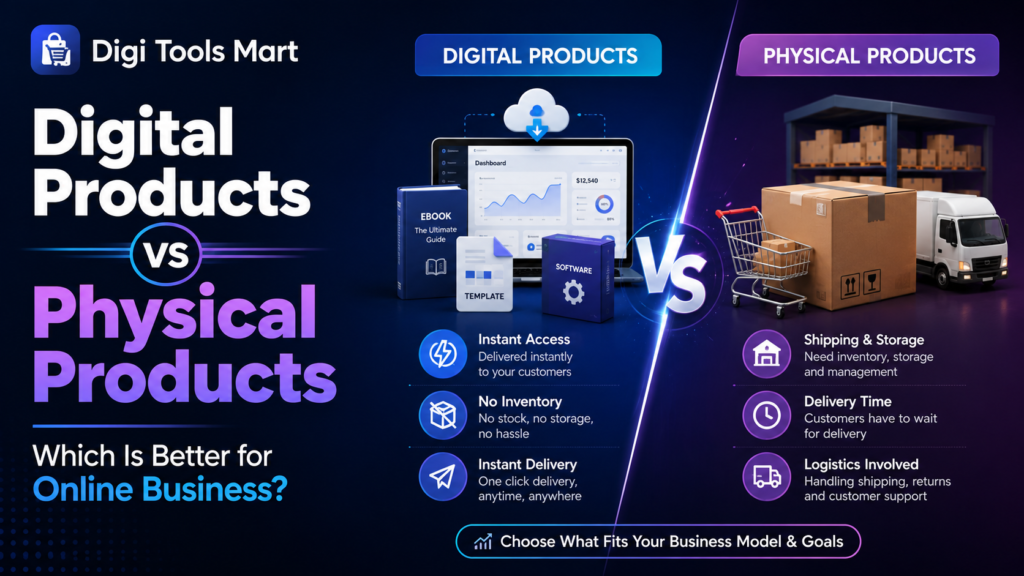
A digital product is something customers receive electronically rather than physically.
Examples include:
- Software
- eBooks
- Online courses
- Templates
- Plugins
- Themes
- Graphics
- Digital subscriptions
Delivery usually happens through downloads, email or online accounts.
What Is a Physical Product?
Physical products are tangible items that must be manufactured, stored and delivered.
Examples include clothing, electronics, books, accessories and household products.
Physical businesses therefore involve logistics that digital businesses may not require.
Inventory
Physical products normally require inventory.
Businesses need to monitor stock levels and decide when to reorder.
Digital products typically do not have the same inventory limitation. A downloadable file can usually be delivered repeatedly without producing another physical copy.
Delivery
Physical products require shipping.
Delivery may take several days and can involve courier fees, packaging, damaged parcels or lost shipments.
Digital products can often be delivered almost instantly after purchase.
Operating Costs
Physical businesses may have expenses including:
- Manufacturing
- Warehousing
- Packaging
- Shipping
- Inventory management
Digital businesses may still have costs such as hosting, software development, licensing, payment processing and customer support, but distribution costs can be lower.
Scalability
Digital products can be highly scalable.
Selling 1,000 downloads does not necessarily require producing 1,000 separate physical items.
However, businesses still need adequate servers, customer support and licensing systems as demand increases.
Customer Experience
Physical products provide something tangible, which many customers value.
Digital products provide convenience and immediate access.
Neither model is automatically better—the best option depends on the customer’s needs.
Can You Sell Both?
Absolutely.
Many businesses successfully combine both models.
For example, a company selling physical business planners might also sell downloadable planner templates.
A training company might sell books alongside online courses.
This creates additional revenue opportunities.
Final Thoughts
Digital products offer advantages in automation, delivery and scalability, while physical products provide tangible customer experiences.
For entrepreneurs who want lower inventory requirements and easier global distribution, digital products can be an attractive starting point.